SPECIAL OFFER!
Time left until the end:


Choose a service
KET tests
KET course
Exam accelerator
First aid course
Regitra routes map
Braking distance/stopping distance
A correct understanding of braking and stopping distances and the ability to assess them in practical situations is extremely important for driving safety. Let's discuss what these concepts mean and what you need to know to ensure safe braking and stopping times.
The braking distance of a car is the distance a vehicle travels from the moment the driver applies the brakes until it comes to a complete stop. This indicator also determines the safety of the car.
The stopping distance of a car is the distance a car travels from the moment the driver notices an obstacle until the car comes to a complete stop.
Reaction time is the distance a car travels from the moment the driver notices an obstacle until the brake pedal is pressed.
Thus, the braking distance depends on technical and environmental circumstances, and the stopping distance additionally includes the driver's reaction time to an obstacle on the road.

Ekis Paprastai
2026 September 9
3 min. read

Many drivers know that stopping becomes more difficult at higher speeds, but not everyone realizes how much the braking and stopping distance actually increases. Incorrect distance estimation often becomes one of the main causes of collisions, especially in heavy traffic or adverse weather conditions.
It is important to understand that a vehicle does not stop instantly upon noticing an obstacle. Before coming to a complete stop, the vehicle travels a certain distance, influenced by the driver's reaction time, driving speed, road surface condition, tire condition, and other factors. The higher the speed, the greater the cost of error.
In this article, we will discuss the difference between braking and stopping distance, the formulas used to calculate them, and the factors that most influence a vehicle's stopping distance. We will also explain why this knowledge is important not only for passing the driving theory exam but also for everyday driving.
Braking Distance – Formula
Braking Distance ≈ (initial speed / 10)²
The initial speed is the initial speed of the vehicle in kilometers per hour (km/h).
This simplified formula is intended to approximately calculate the braking distance of a typical light vehicle in meters under normal road conditions.
Another stopping distance formula is provided by AASHTO:
S = (0.278 T V) + V² / (254 * (F + G))
S – stopping distance (meters)
T – driver's reaction time (seconds)
V – vehicle speed (km/h)
F – friction coefficient between the tire and the road. For dry road surfaces – 0.7, for wet – between 0.3 and 0.4
G – road gradient, expressed as a decimal. It is positive when driving uphill and negative when driving downhill
However, remember that even considering the formulas, the actual braking distance can vary due to factors such as:
road conditions,
vehicle and tire condition,
tire type,
driver's reaction time.
Why is it Important to Understand Stopping Distance?
Avoid Collisions. Knowing your vehicle's braking distance allows you to maintain a safe distance from the vehicle in front and reduce the risk of an accident. Also, in heavy traffic, sudden braking may cause the vehicle behind you to collide with you. Understanding braking and stopping distance is especially important when driving at high speeds, as increasing speed lengthens the distance traveled during the driver's reaction time, the braking distance, and the stopping distance.
Knowledge of braking distance becomes particularly important in adverse weather conditions, as the road surface can become slippery. Drivers must adjust their speed and braking accordingly to maintain vehicle control and avoid collisions.
Driving theory tests may include questions that define braking distance (from brake application to complete stop) and stopping distance (from the moment the driver sees an obstacle to complete stop).

Frequently asked questions
Here you will find answers to common questions. If you did not find your question, click Contact us and we will gladly help.

Did not find an answer?
Contact us and we will help!
Information updated 2026-09-09
Related articles
2026 August 31
6 min. read
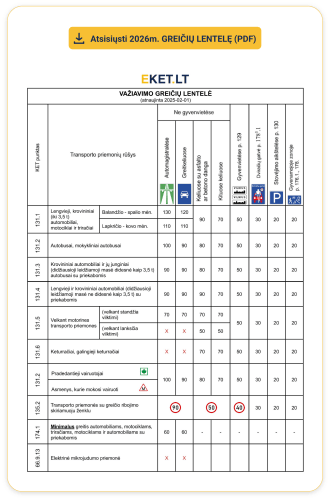
KET Speed Table 2026 PDF (permitted driving speeds)

Ekis Paprastai

2026 September 3
7 min. read
Categories A, A1, A2, AM
Ekis Paprastai

2026 September 3
4 min. read
Vehicle Categories and Their Classification (Descriptions)
Ekis Paprastai
2026 September 1
8 min. read
B, B1, BE Categories
Ekis Paprastai
Other articles
Car dashboard symbols and their meanings
Category D
Driving with the M Plate: Requirements, Opportunities, Pros and Cons, FAQ
When do you need to retake your driving license? [2026 Information]
AM CATEGORY TESTS (AM, A, A1, A2 Category Driving Theory Tests)
C kategorija
Beginner Driver: License, Tips, Traffic Violations
Top 7 Tips for Choosing the Best Driving Theory Test Website in 2026
Common Mistakes in the "Regitra" Theory Exam and How to Avoid Them
I failed the Regitra theory exam – what to do? A retake guide
Driving categories 2026: Descriptions, requirements, notes
Do KET tickets match the "Regitra" exam? What is worth knowing
Tractor driving license: categories, requirements, costs
Regitra questions – 20 questions before the practical exam 2026
(NON) Critical Errors at Regitra: Possible Error Types 2026
Regitra Exam Fees – Theory and Practical License Costs
Paid vs Free Driving Theory Tests: What Are the Differences and What to Choose in 2026
How to Quickly Pass the Driving Theory Exam at "Regitra" (on the First Try)
Lost driver's license: recovery, retaking exams, required documents
How to Quickly Pass the Driving Theory Exam at "Regitra": A Plan That Works the First Time
Are the driving theory test questions too difficult? What to do if you're struggling
Regitra theory exam 2026: procedure, cost, requirements
Driving Lessons: Requirements, Where to Learn, Price, FAQ
How to Quickly Learn Driving Theory Test Questions: Step by Step
Driving exam 2026: school test, at Regitra, mistakes
How to Effectively Overcome Stress in the Driving Exam: A Practical Guide
How to Effectively Prepare for the "Regitra" Theory Exam: A Practical Guide
What do the regulator signals mean?
Railway crossing
Best KET tests (tickets) 2026
What is the difference between the theory exams for categories A, B, C, and D at "Regitra"?
Traffic fines: speeding, driving without inspection and other violations 2026



EKET.LT - More than just KET tests
EKET.LT is an innovative learning system helping you prepare for the Regitra theory exam. You will find not only KET tickets and tests here, but also constantly updated content, learning statistics, recommendations and the option to consult with an experienced instructor. Learn more effectively, track your progress and get ready to pass on the first try.
Copying or reusing any material published on “EKET.LT” is prohibited. 2021 - 2026.