SPECIAL OFFER!
Time left until the end:


Choose a service
KET tests
KET course
Exam accelerator
First aid course
Regitra routes map
How to Effectively Prepare for the "Regitra" Theory Exam: A Practical Guide
It is possible to effectively prepare for the "Regitra" theory exam in 2–4 weeks if the learning process is active rather than passive reading of the material. Many candidates fail to pass on the first attempt not due to the complexity of the material, but because of an inappropriate strategy: memorizing questions, not analyzing mistakes, and compressing preparation into the last night.
A targeted system includes three elements: understanding of the Road Traffic Rules (KET) theory, error analysis, and simulated 30-question tests under real conditions. Such a structure not only allows passing the exam but also acquiring real knowledge that will be useful while driving.
Below you will find a specific preparation plan, a list of the most common mistakes, problematic topics with the highest error rates, and answers to practical questions about the external procedure, exam languages, and retake procedures.

Ekis Paprastai
2026 September 16
8 min. read

How to Effectively Prepare for the "Regitra" Theory Exam?
The most effective preparation lasts 7–14 days of active learning for 30–45 minutes daily, combining theory reading, solving tickets, and simulated tests. This pace allows you to absorb the material in layers, rather than cramming everything into the last night.
Specific 14-day plan:
Days 1–3: reading the paper KET booklet, traffic rules, road signs, first aid, vehicle operation.
Days 4–10: solving tickets by topics (intersections, priority, signs, speed, first aid), analyzing each mistake.
Days 11–14: full 30-question simulated tests within the time limit, until a stable result of ≥28/30 is achieved.
The last week is dedicated to revision only, so it is not recommended to start new topics during this time.
Spaced Repetition: Why Does Interval Repetition Work?
Repeating weak topics after 1, 3, and 7 days is more effective than cramming everything right before the exam, as the information is retained in long-term memory. One-time intensive cramming gives a short-term effect, but in the exam, when the question is phrased differently, the memorized answer does not work.
Main Preparation Tools
Preparation requires three layers: a paper KET booklet as the theoretical foundation, an online ticket platform with error analysis, and video lectures for complex topics (intersections with a regulator, M letter rules). When solving KET tests online, it is worth paying attention to the explanations for each answer.
Paid tickets are usually more comprehensive than free ones: they have more question variants, are updated according to the "Regitra" methodology, and provide explanations of why the answer is correct. Free sets often lack the latest questions and contextual illustrations.
Active Learning Principle
Passive reading does not work. An effective sequence: take the test → analyze each mistake → read the explanation → return to the topic in the KET booklet. Only this way do gaps get filled, rather than repeating on exam day.
How to Pass the Theory Exam 100% on the First Try?
The basis for a guaranteed result is a clear preparation indicator: consistently passing a full 30-question test with no more than 2 mistakes several times in a row on different days. One good result means nothing, it could be a coincidence. Stability over several days shows real knowledge.
The category B exam consists of 30 questions with a limited time limit and a strictly defined number of allowable mistakes. It is worth checking the current standards on the "Regitra" theory exam page, as requirements are occasionally updated.
On exam day, a simple routine is important. Get enough sleep, eat, arrive 15–20 minutes early, and have your identity document and first aid certificate. Last-minute rushing causes unnecessary stress, which directly affects answer accuracy.
Strict rules apply in the classroom. Phones, smartwatches, and earbuds are prohibited, and talking or looking at neighbors' screens is not allowed. These rules apply equally to everyone, regardless of the exam language.
The consequences of cheating are serious. If a violation is recorded, the person is banned from taking the theory exam for one year, so the risk is disproportionate to any possible benefit.
The emotional aspect often determines the result. Stress arises from uncertainties and doubts, so the best calming factor is to achieve a score of ≥28/30 before going to the exam. When tests are consistently solved at home, in the classroom, it remains only to repeat the same process.
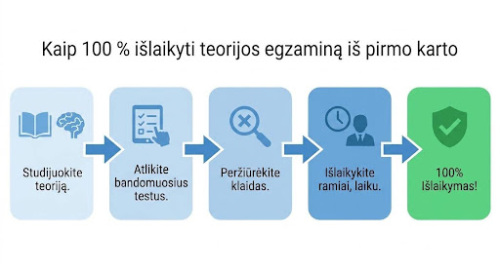
How to Pass the Theory Exam 100% on the First Try Infographic
Self-Study vs. Driving School Theory Courses
The external method means preparing for the theory independently using the KET booklet and tickets, without driving school lectures. The document requirements remain the same: a medical certificate (form 083-1/a) and a first aid certificate from an accredited institution, without which "Regitra" will not accept registration for the exam.
Advantages of self-study:
Flexibility, you study when convenient, without a fixed lecture schedule.
Lower cost, you only pay for ticket access, a medical certificate, and a first aid course.
Your own pace, you can spend more time on weak topics and skip what you already know.
Disadvantages are also real. There is no clear program, so it is easy to miss important topics. If you have a question about a complex intersection or priority, you have no one to ask immediately. Motivation easily drops when no one is waiting for you in a lecture.
Driving school theory courses are suitable for those who want a structured program, live lectures, and the opportunity to discuss specific cases, such as intersections with a regulator or priority nuances. Discussion with an instructor often helps to understand the logic faster than solitary booklet reading.
A hybrid option is a smart compromise: remote lectures with an instructor provide structure, while self-solving tickets allow you to learn at your own pace at a lower cost.
Remember that the school exam at the driving school is valid for a limited time (check the current term on the "Regitra" website), so the "Regitra" exam date needs to be planned in advance to ensure the result does not lose validity.
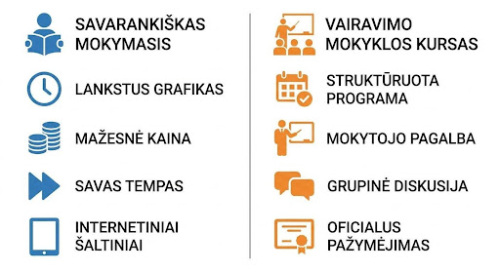
Self-Study vs. Driving School Theory Courses Infographic
Common Mistakes When Preparing for the Theory Exam
Most time is wasted due to incorrect learning habits, not the complexity of the material. The mistakes listed below are the most common and lead to not passing on the first try.
Memorizing answers instead of searching for logic. In the "Regitra" exam, the same situation is presented with different circumstances or a rephrased question, so a memorized answer misleads when the context is changed. Instead of memorizing answer letters, you need to remember the logic of the rule and why that decision is correct.
Ignoring the paper KET booklet. Solving tickets alone without a theoretical foundation leaves gaps in first aid steps, vehicle operation requirements, and questions about liability for violations. The booklet provides a system, and the tickets only test it.
Irregular learning. One long session on the weekend is not as effective as 30–45 minutes daily; information is retained through repetition, not through a one-time immersion. The brain consolidates knowledge during sleep, so short daily sessions yield a stronger result.
Using only free tickets. Free sources are often incomplete, do not cover all question variants, and lack explanations for answers, so mistakes remain uncorrected. You will find a full question bank and explanations by reviewing traffic rules and thematic tests.
Not analyzing mistakes. The test is solved, the result is seen, but incorrect answers are not read. The same mistake will recur in the exam if it was not fully understood.
Not observing traffic in everyday life. While riding a bus or walking, it is worth paying attention to signs, intersections, and priority situations, as this strengthens the application of theory in a real context.
Most Commonly Failed Questions and How Not to Miss Them
Most mistakes recur in a few topics: intersections with a regulator and determining priority, nuances of similar-looking traffic signs, first aid steps (CPR, bleeding control, shock), railway crossing rules, and speed regimes on different roads.
These topics are complex because they require not memorization but the application of logic in a specific situation.
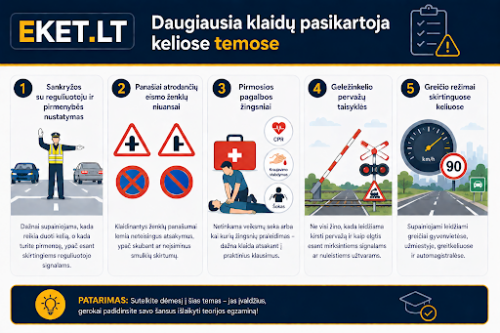
Intersection and Priority Questions
Intersections with a regulator pose the most difficulties because they require coordinating three layers of signals at once: the regulator's gestures, traffic light signals, and priority signs. Students get used to evaluating only one element, so they get confused when they see a regulator along with a green traffic light.
The logic hierarchy is simple and worth remembering: the regulator's gestures take precedence over the traffic light, the traffic light takes precedence over priority signs, and signs take precedence over road markings. Knowing this sequence, most "tricky" questions are solved instantly.
A common mistake is in the reverse situation, where the intersection is completely unregulated and there are no signs. Then the right-hand rule applies, but it is often forgotten.
It is advisable to solve a separate thematic KET test for intersections until the result is consistently error-free.
Nuances of Traffic Signs and "Tricky" Question Formulations
Prohibitory signs (red border) prohibit an action, while mandatory signs (blue background) instruct to perform an action. The most common confusion arises between stopping and parking prohibition: the former prohibits any stopping, the latter allows a brief stop for passenger boarding or unloading cargo.
Additional plates change the validity of the main sign, indicating distance, time, or vehicle type. The same sign with a different plate can mean a completely different rule, so both elements need to be read together.
"Tricky" questions often have two similarly sounding answers, distinguished by one key word: "always," "only," "except," "prohibited." Read the question twice and mentally mark these words before choosing an answer.
It is worth checking speed regimes in different locations in the speed table to memorize the numbers without confusion.

Frequently asked questions
Here you will find answers to common questions. If you did not find your question, click Contact us and we will gladly help.

Did not find an answer?
Contact us and we will help!
Information updated 2026-09-16
Related articles

2026 September 14
6 min. read
How to Quickly Pass the Driving Theory Exam at "Regitra": A Plan That Works the First Time

Ekis Paprastai

2026 September 8
6 min. read
How to Quickly Pass the Driving Theory Exam at "Regitra" (on the First Try)
Ekis Paprastai

2026 September 1
8 min. read
Regitra theory exam 2026: procedure, cost, requirements
Ekis Paprastai

2026 September 3
7 min. read
Categories A, A1, A2, AM
Ekis Paprastai
Other articles
Car dashboard symbols and their meanings
Category D
Driving Lessons: Requirements, Where to Learn, Price, FAQ
How to Quickly Learn Driving Theory Test Questions: Step by Step
Regitra questions – 20 questions before the practical exam 2026
(NON) Critical Errors at Regitra: Possible Error Types 2026
Regitra Exam Fees – Theory and Practical License Costs
What do the regulator signals mean?
Top 7 Tips for Choosing the Best Driving Theory Test Website in 2026
Common Mistakes in the "Regitra" Theory Exam and How to Avoid Them
Driving categories 2026: Descriptions, requirements, notes
Vehicle Categories and Their Classification (Descriptions)
Driving with the M Plate: Requirements, Opportunities, Pros and Cons, FAQ
Driving exam 2026: school test, at Regitra, mistakes
KET Speed Table 2026 PDF (permitted driving speeds)
B, B1, BE Categories
Beginner Driver: License, Tips, Traffic Violations
Lost driver's license: recovery, retaking exams, required documents
What is the difference between the theory exams for categories A, B, C, and D at "Regitra"?
Traffic fines: speeding, driving without inspection and other violations 2026
Do KET tickets match the "Regitra" exam? What is worth knowing
Tractor driving license: categories, requirements, costs
Braking distance/stopping distance
When do you need to retake your driving license? [2026 Information]
AM CATEGORY TESTS (AM, A, A1, A2 Category Driving Theory Tests)
C kategorija
Railway crossing
Best KET tests (tickets) 2026
I failed the Regitra theory exam – what to do? A retake guide



EKET.LT - More than just KET tests
EKET.LT is an innovative learning system helping you prepare for the Regitra theory exam. You will find not only KET tickets and tests here, but also constantly updated content, learning statistics, recommendations and the option to consult with an experienced instructor. Learn more effectively, track your progress and get ready to pass on the first try.
Copying or reusing any material published on “EKET.LT” is prohibited. 2021 - 2026.