SPECIAL OFFER!
Time left until the end:


Choose a service
KET tests
KET course
Exam accelerator
First aid course
Regitra routes map
How to Quickly Pass the Driving Theory Exam at "Regitra": A Plan That Works the First Time
It is possible to quickly pass the driving theory exam at "Regitra" within 5–7 days if the learning is focused on understanding the logic of the rules rather than mechanically memorizing answers. Most candidates stumble not due to a lack of knowledge, but because of rushing, not reading questions carefully, and relying on the "first instinct," all of which can be avoided with a clear plan.
The Category B theory exam consists of 30 questions in 45 minutes, and a positive result requires 26 correct answers. It seems simple, but according to statistics published by VĮ "Regitra," some candidates do not pass on the first attempt because they prepare chaotically and without structure.
Below is a specific 7-day preparation plan, an explanation of the number of questions and evaluation by categories, the most common reasons for failure, and practical tips for exam day at "Regitra."

Ekis Paprastai
2026 September 14
6 min. read

How to Quickly Prepare for the Driving Theory Exam at Regitra: 7-Day Plan
The realistic minimum is 5–7 days of intensive study for 2–3 hours per day for a fast-learning student, while an average learner is recommended 2–4 weeks. The pace depends not on the number of days, but on how deeply you understand the logic of the rules.
It is important to know the order: the theory exam at "Regitra" can only be taken after completing the initial training course at a driving school. First, the school exam is taken, then the "Regitra" theory exam. Without this step, registration in "Regitra's" self-service is impossible.
Memorizing test answers does not work, as the official question database rotates formulations and arrangement of options. The same rule point can be presented in ten ways, so understanding is the only reliable preparation method.
Ultimately, knowledge is needed not for the exam, but for safe driving on the road. The logic of intersection priority, speed regimes, and traffic controller signals are resolved in real situations within seconds.
Specific 7-Day Preparation Plan
D1–D2: Theoretical Foundation. Read the driving theory book from start to finish, focusing on groups of road signs: warning, prohibitory, directional, and informational. Note principles, not names, as the logic of signs repeats in all tests.
D3–D4: Solving Tests. Start solving the free driving theory test and record each mistake in a separate notebook with a brief explanation of why the answer is incorrect. This method works better than retaking the test repeatedly.
D5: Review of Weakest Topics. Focus on the areas where you most often stumble: permissible speed regimes in cities and rural areas, intersections without signs (right-hand rule), and meanings of traffic controller signals.
D6: Error Analysis. Read through the entire week's error notebook and re-solve only those topics where there were the most inaccuracies. This saves time and strengthens weak areas.
D7: Mock Exams. Take two or three full tests under real conditions: 30 questions, 45 minutes, without breaks and phone. If you achieve 28+ correct answers in each, you are ready for "Regitra".
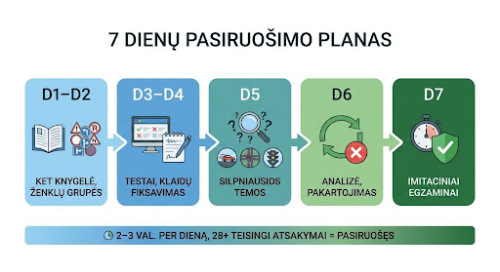
7-Day Driving Theory Exam Preparation Plan – Step-by-Step Schedule with Daily Topics and Tasks
Number of Questions, Duration, and Evaluation by Categories
The B category theory exam at "Regitra" consists of 30 questions, to be solved in 45 minutes, and a positive result requires correctly answering at least 26 questions, allowing up to 4 mistakes. Questions are presented on a computer in random order from the official database, so two candidates in the same room solve different sets.
For A, C, and D categories, the number of questions and the allowed error margin slightly differ, as specific risks and the nature of vehicle control are assessed. Check the exact current numbers in "Regitra's" self-service regitra.lt before registration, as requirements are occasionally adjusted according to the Ministry of Transport's regulations.
Questions cover six main topic groups:
Road Signs: warning, prohibitory, directional, informational.
Traffic Rules: priority, overtaking, stopping, speed regimes.
Traffic Controller Signals and traffic light coordination.
Risk Perception and safe distance principles.
First Aid at the scene.
Vehicle Control and technical condition.
The question database is not publicly disclosed, so memorizing all options is impossible. However, preparation can be done with tests structured according to the same official structure and formulation logic, allowing recognition of typical question models.
Read more about evaluation principles and question distribution in the theory exam overview, where the importance of each topic group to the final result is explained.
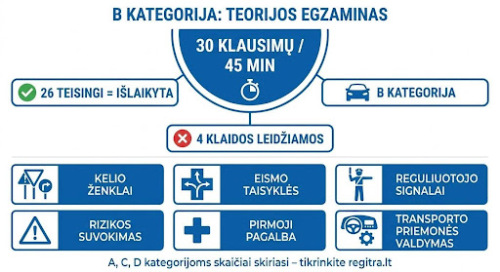
Driving Theory Exam Structure – Number of Questions, Duration, Allowed Mistakes, and Topic Groups for B Category
How Difficult is the Driving Theory Exam and Common Reasons for Failure
The driving theory exam is not difficult for those who understand the logic of the rules, but becomes challenging for those who try to memorize answers. The difference is determined by the learning method, not intelligence or age.
"Regitra" annually publishes the results of theory and practical exams in its annual activity report, showing that a significant portion of candidates do not pass the exam on the first try. Statistics show a clear pattern: those who fail are not those who studied little, but those who studied incorrectly.
Three most common mistakes can be identified quite accurately:
Memorizing test answers without understanding. Regitra's database rotates questions and changes formulations, so memorized option letters do not help when the same principle is presented from a different angle.
Not reading the question carefully to the end. Candidates often decide after reading half a sentence, although the essential condition ("except", "if there are no signs") lies at the end.
Rushing and guessing on first instinct. With 45 minutes for 30 questions, there is enough time to read each twice, but stress prompts quicker choices.
Question formulations often have several logically sounding options, where only one matches the exact driving theory regulation. Such formulation tricks require attention, not speed.
A broader list with examples can be found in the article on common mistakes at "Regitra", which helps to recognize traps in advance before taking the exam.
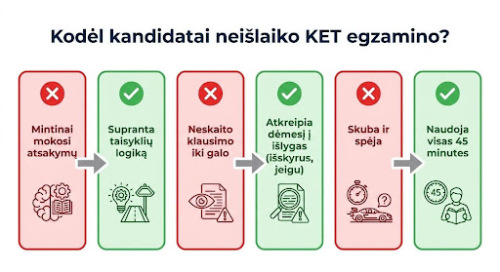
Common Reasons for Failing the Driving Theory Exam at "Regitra" and How to Avoid Them – Comparison Chart
Registration, Documents, and Exam Day at "Regitra"
Registration for the theory exam is possible only through "Regitra's" self-service regitra.lt, selecting a specific branch, date, and time. Registration by phone or in person is no longer conducted, so an account in the self-service is a mandatory condition.
Before registration, ensure you have all the necessary documents, as you will not be admitted without them:
Identity document (passport or ID card).
Medical certificate (form 083-1/a) from a family doctor.
First aid course certificate.
Driving school completion certificate with a passed exam.
Exam fees vary by category and number of attempts, so before registering, it is worth reviewing the current "Regitra" fee list to avoid misunderstandings in the self-service.
Arrive at the "Regitra" branch 15–20 minutes early to register at the reception and calm down. Turn off your phone or leave it in the cloakroom, as electronic devices, notes, or looking at another candidate's screen are prohibited during the exam. Violating these rules will result in the exam being immediately terminated and counted as failed.
In popular branches, especially in Vilnius and Kaunas, available dates are sometimes booked weeks in advance. If you do not want to wait, you can use the exam date acceleration, the system automatically monitors available times and moves you to a closer date without additional actions.

Frequently asked questions
Here you will find answers to common questions. If you did not find your question, click Contact us and we will gladly help.

Did not find an answer?
Contact us and we will help!
Information updated 2026-09-14
Related articles

2026 September 8
6 min. read
How to Quickly Pass the Driving Theory Exam at "Regitra" (on the First Try)

Ekis Paprastai

2026 September 8
6 min. read
How to Quickly Learn Driving Theory Test Questions: Step by Step
Ekis Paprastai

2026 September 3
7 min. read
Categories A, A1, A2, AM
Ekis Paprastai
2026 September 8
6 min. read
Do KET tickets match the "Regitra" exam? What is worth knowing
Ekis Paprastai
Other articles
Car dashboard symbols and their meanings
Traffic fines: speeding, driving without inspection and other violations 2026
Driving Lessons: Requirements, Where to Learn, Price, FAQ
Driving exam 2026: school test, at Regitra, mistakes
KET Speed Table 2026 PDF (permitted driving speeds)
B, B1, BE Categories
Beginner Driver: License, Tips, Traffic Violations
Lost driver's license: recovery, retaking exams, required documents
Driving categories 2026: Descriptions, requirements, notes
Category D
Driving with the M Plate: Requirements, Opportunities, Pros and Cons, FAQ
Braking distance/stopping distance
When do you need to retake your driving license? [2026 Information]
AM CATEGORY TESTS (AM, A, A1, A2 Category Driving Theory Tests)
C kategorija
Railway crossing
Best KET tests (tickets) 2026
Regitra theory exam 2026: procedure, cost, requirements
Vehicle Categories and Their Classification (Descriptions)
Tractor driving license: categories, requirements, costs
Regitra questions – 20 questions before the practical exam 2026
(NON) Critical Errors at Regitra: Possible Error Types 2026
Regitra Exam Fees – Theory and Practical License Costs
What do the regulator signals mean?
Top 7 Tips for Choosing the Best Driving Theory Test Website in 2026
Common Mistakes in the "Regitra" Theory Exam and How to Avoid Them



EKET.LT - More than just KET tests
EKET.LT is an innovative learning system helping you prepare for the Regitra theory exam. You will find not only KET tickets and tests here, but also constantly updated content, learning statistics, recommendations and the option to consult with an experienced instructor. Learn more effectively, track your progress and get ready to pass on the first try.
Copying or reusing any material published on “EKET.LT” is prohibited. 2021 - 2026.