SPECIAL OFFER!
Time left until the end:


Choose a service
KET tests
KET course
Exam accelerator
First aid course
Regitra routes map
Common Mistakes in the "Regitra" Theory Exam and How to Avoid Them
Most candidates who fail the "Regitra" theory exam do not do so because they are unaware of the Traffic Rules. More often, problems arise from not reading the questions carefully, misinterpreting road signs, or attempting to memorize answers by rote. This is why even well-prepared candidates sometimes do not reach their full potential.
This is also reflected in the statistics. In 2025, only 38.3% of candidates passed the Category B theory exam on their first attempt, making every mistake significant. Knowing which topics commonly cause difficulties and in which situations candidates most often err makes preparation much more targeted and effective.
In this article, we will discuss the most common mistakes in the "Regitra" theory exam, the most challenging topics, and practical ways to avoid them. You will also learn how many mistakes can be made, how to study effectively, and what to do to maximize the likelihood of passing the exam on the first try.

Ekis Paprastai
2026 September 14
6 min. read

Common Mistakes in the "Regitra" Theory Exam
Most candidates make mistakes due to four recurring reasons: incorrect interpretation of road signs, confusion with horizontal markings, failure to recognize signals from traffic controllers and traffic lights, and hasty and inattentive reading of questions.
Learning questions by heart, also known as "cramming," often leads to failure. "Regitra" uses various question formulations where numbers or details of traffic situations may be changed, making a memorized answer option incorrect. Without understanding the essence of the rule, a candidate makes a mistake as soon as a detail of the context changes.
Statistics show that this problem is very relevant. In 2025, only 38.3% of candidates passed the Category B theory exam on the first attempt, meaning more than 6 out of 10 candidates failed. This trend is worsening: in 2024, the pass rate was 40.7%, and in 2023, it was 42.7%.
Psychological factors also contribute to mistakes. One of the most common is overconfidence. Candidates often overestimate how many correct answers they have chosen, thus stopping their studies too early, even though their knowledge is not yet solid enough.
On the opposite side, haste caused by anxiety plays a role. Exam anxiety is associated with poorer results because an anxious candidate reads the question superficially and chooses the first seemingly correct option.
Time management becomes a crucial factor here. An unanswered question, when the allotted time expires, is counted as a mistake just like an incorrect answer. Therefore, rushing at the beginning of the exam, leaving more complex questions for the end, can result in not having time to answer some of them.
In other words, most mistakes arise not from a lack of knowledge but from improper preparation strategies and nervous tension. By understanding the logic of traffic rules and regularly solving tests according to the "Regitra" methodology, these mistakes can be avoided.
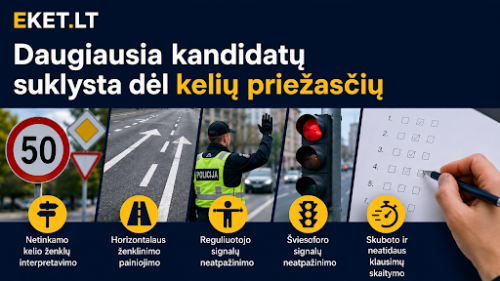
The Most Difficult Theory Exam Topics: Road Signs and Markings
Most incorrect answers occur in the topics of road signs and road markings, as the candidate needs not only to recognize the sign but also to understand its area of validity and interaction with other signs.
These topics require logical thinking rather than mechanical memorization, so it is worth repeating them using real situational examples and diagrams that show how rules are applied in specific traffic situations.
Interpretation of Road Signs and Additional Plates
Priority signs are most often misinterpreted, confusing the main and secondary roads, as well as prohibitory signs, especially the differences between stopping and parking prohibitions. Stopping means a short-term halt of the vehicle, while parking means keeping the vehicle stationary for a longer period, so the conditions for applying these prohibitions differ.
Additional plates cause the most confusion as they change the conditions of the main sign's validity. A plate can indicate the sign's validity time, distance, or the group of vehicles to which a specific rule applies, so the correct answer depends on the entire combination of signs.
Therefore, it is worth learning by understanding the purpose of the sign in a specific situation, rather than just memorizing its name. The exam presents real traffic situations where the most important thing is to logically apply the rules.
Horizontal Road Markings and Special Signals
Errors in horizontal markings are most often related to the rules for crossing solid and dashed lines. Crossing a solid line is prohibited, while crossing a dashed line is allowed, so candidates often make mistakes when both lines are presented together and they need to consider which side their traffic lane is on.
A double solid line completely prohibits overtaking and entering the oncoming traffic lane, so each situation must be assessed according to the specific road view.
Traffic controller signals are often confused with traffic light signals, as different positions of the controller's arms mean different instructions for road users. The controller's instructions take precedence over traffic light signals and road signs, so it is essential to know their meanings precisely.
Special signals cause confusion because the obligation to give way depends on whether the special vehicle is using an audible signal. These topics deserve more time, as candidates make the most mistakes in them.
How Many Mistakes Can Be Made in the "Regitra" Theory Exam?
The Category B theory exam consists of 30 questions, and the exam is considered passed if at least 80% of the questions are answered correctly. This means that no more than 6 mistakes can be made.
It is important to understand that a mistake can be counted in two ways. Each incorrect answer is counted as a mistake, but an unanswered question is also considered a mistake if the allotted time expires. Therefore, proper time management becomes one of the most important conditions for passing the exam.
The evaluation of the theory exam differs from the evaluation of the practical exam. In the theory exam, the total number of correct answers is assessed, while in the practical exam, mistakes are categorized as critical, dangerous, and non-critical. One critical mistake in the practical exam immediately means failure, so its evaluation is stricter and less forgiving.
This strictness is confirmed by statistics. In 2025, an even smaller portion of candidates passed the practical exam on the first attempt: with a manual transmission – 27.8%, and with an automatic – 26.3%. Compared to the theory exam result (38.3%), it is clear that both parts of the exam require thorough preparation. When preparing for the practical exam, it is useful to familiarize yourself with the most commonly used "Regitra" exam routes, as this helps to better understand the assessed situations and reduce stress during the exam.

How to Prepare and Pass the Theory Exam on the First Try?
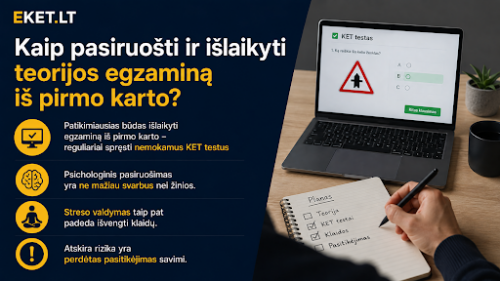
The most reliable way to pass the exam on the first try is to regularly solve free KET tests, compiled according to the "Regitra" methodology, analyze each mistake made, and understand the logic of traffic rules, rather than memorizing the answer's location or its position among the options.
Learning questions by heart is not effective because "Regitra" uses various formulations of the same situations. Changing the question formulation, numbers, or the position of a road sign can make a memorized answer incorrect. Therefore, only understanding traffic rules allows for correct answers even to modified questions.
Psychological preparation is as important as knowledge. The widely held belief that the first chosen answer is always better left unchanged is a myth known as the first instinct fallacy. Research shows that changing an answer when in doubt more often improves rather than worsens the result, so it is worth reviewing questions that raise doubts.
Stress management also helps avoid mistakes. Exam anxiety is associated with poorer results, and repeatedly solving tests reduces uncertainty, so on exam day, candidates feel calmer and answer more carefully.
An additional risk is overconfidence. Candidates often overestimate how many correct answers they have chosen, so they often stop studying too early. It is safer to study until tests are solved consistently and good results are achieved, rather than stopping after the first successful attempt.
Time is used most effectively when focusing on the weakest topics. Simulated tests, compiled according to the "Regitra" methodology, with detailed explanations and an individual learning program that automatically identifies the most common mistakes, help to repeat precisely those topics where difficulties still arise.

Frequently asked questions
Here you will find answers to common questions. If you did not find your question, click Contact us and we will gladly help.

Did not find an answer?
Contact us and we will help!
Information updated 2026-09-14
Related articles

2026 September 8
6 min. read
How to Quickly Pass the Driving Theory Exam at "Regitra" (on the First Try)

Ekis Paprastai

2026 September 14
6 min. read
How to Quickly Pass the Driving Theory Exam at "Regitra": A Plan That Works the First Time
Ekis Paprastai

2026 September 3
7 min. read
Categories A, A1, A2, AM
Ekis Paprastai

2026 September 1
8 min. read
Regitra theory exam 2026: procedure, cost, requirements
Ekis Paprastai
Other articles
Car dashboard symbols and their meanings
Category D
Driving Lessons: Requirements, Where to Learn, Price, FAQ
How to Quickly Learn Driving Theory Test Questions: Step by Step
Regitra questions – 20 questions before the practical exam 2026
(NON) Critical Errors at Regitra: Possible Error Types 2026
Regitra Exam Fees – Theory and Practical License Costs
What do the regulator signals mean?
Top 7 Tips for Choosing the Best Driving Theory Test Website in 2026
Driving categories 2026: Descriptions, requirements, notes
Vehicle Categories and Their Classification (Descriptions)
Driving with the M Plate: Requirements, Opportunities, Pros and Cons, FAQ
Driving exam 2026: school test, at Regitra, mistakes
KET Speed Table 2026 PDF (permitted driving speeds)
B, B1, BE Categories
Beginner Driver: License, Tips, Traffic Violations
Lost driver's license: recovery, retaking exams, required documents
Traffic fines: speeding, driving without inspection and other violations 2026
Do KET tickets match the "Regitra" exam? What is worth knowing
Tractor driving license: categories, requirements, costs
Braking distance/stopping distance
When do you need to retake your driving license? [2026 Information]
AM CATEGORY TESTS (AM, A, A1, A2 Category Driving Theory Tests)
C kategorija
Railway crossing
Best KET tests (tickets) 2026



EKET.LT - More than just KET tests
EKET.LT is an innovative learning system helping you prepare for the Regitra theory exam. You will find not only KET tickets and tests here, but also constantly updated content, learning statistics, recommendations and the option to consult with an experienced instructor. Learn more effectively, track your progress and get ready to pass on the first try.
Copying or reusing any material published on “EKET.LT” is prohibited. 2021 - 2026.